

Screw conveyors, or grain augers, move bulk materials from one place to another. For instance, imagine harvest time on a large farm. Trucks unload bushels of corn. Yet, silos stay empty because moving grain is slow. Then, a stainless steel trough conveyor starts. Consequently, it lifts grain quickly into storage. As a result, workers stay busy and waste falls dramatically.
Why Screw Conveyors Matter
Because they combine simple design with reliable performance, screw conveyors are a top choice across many industries:
- Farming: They move grain, feed, and seeds into bins or mixers.
- Food Plants: Stainless steel augers meet strict hygiene rules.
- Mining: Heavy-duty screws handle ore, sand, and gravel.
Moreover, they cut labor costs, reduce material waste, and keep areas clean. Therefore, work becomes safer and profits rise.
Main Types of Screw Conveyors
Trough Screw Conveyors
Trough screw conveyors use an open U-shaped channel. As a result, materials like wheat or soybeans flow easily. Additionally, the open top makes cleanup fast.
Tubular Screw Conveyors
In contrast, tubular screw conveyors feature a sealed round tube. Consequently, they stop dust, spills, and moisture. Hence, they work well with powders. As such, food and chemical plants use them to stay clean.
Stainless Steel Screw Conveyors
When rust is a concern, stainless steel helps. It meets FDA standards and resists corrosion. Therefore, bakers and dairy plants count on these models.
Grain Augers and Vertical Conveyors
A grain auger is a vertical screw in a tube. Thus, it lifts grain from the ground into silos. Consequently, farmers fill or empty bins with ease.
How Screw Conveyors Work
A screw conveyor has a spiral blade wrapped around a rod. Then, a motor turns the rod. As a result, the blade
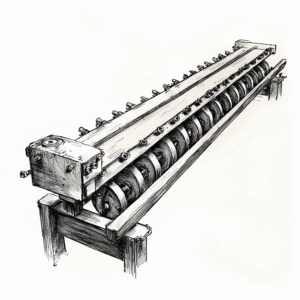
moves material along a trough or tube.
Key parts:
-
- Drive Unit: Motor and gearbox set speed (30–60 RPM).
- Flight & Shaft: Spiral blade on a shaft carries material.
- Housing: A trough or tube holds the material.
- Inlet & Discharge: Points where material goes in and out.
Factors to consider:
- Pitch: Distance between blade edges. Larger pitch moves more material.
- Diameter: Wider blades hold more but need more power.
- Speed: Faster speeds move material quicker but can damage the product.
- Fit: A tight blade-to-housing fit reduces slip but increases wear.
Case Study: Iowa Grain Farm
For example, Smith Family Farms had a jammed auger every few hours. Then, they upgraded to a custom carbon-steel trough screw conveyor by Orthman. And as a result:
- Throughput rose 25% (400 to 500 bushels/hour).
- Downtime fell from 10 to 2 hours per month.
- Breakage dropped 15%.
Thus, they recouped costs in six months and soon ordered another unit. Consequently, their harvest moved faster and grain loss dropped.
Picking the Right Conveyor
To choose the right model, ask yourself:
- What is the material? (Dusty, wet, or sticky?)
- How much do you move? (Tons or bushels per hour.)
- What is the layout? (Horizontal, inclined up to 45°, or vertical.)
- What steel type? (Carbon or stainless.)
- What flight style? (Standard, paddle, or no-shaft for sticky loads.)
Selection Guide:
| Use Case | Type | Steel | Notes |
|---|---|---|---|
| Dry grains | Trough auger | Carbon | Easy to clean |
| Powders | Tubular conveyor | Stainless | Dust-free operation |
| Sticky materials | Shaftless auger | Stainless | No clogging |
| Vertical lift | Grain auger (tube) | Carbon | High lift performance |
Maintenance Tips
Good care extends conveyor life:
- Grease bearings each month.
- Check blade and shaft wear regularly.
- Clean tubes with air or water.
Additionally, replace worn parts quickly. Therefore, you avoid major breakdowns and keep uptime high.
Image Placeholder: Technician inspecting a screw conveyor.
Why Choose Orthman’s Custom Conveyors
Orthman makes custom screw conveyors for your needs. We offer:
- Carbon or stainless steel construction.
- Trough, tubular, shaftless, or paddle flights.
- Sizes from 4″ to 18″ diameter, and lengths over 100′.
- Gearboxes, belt drives, or direct drives.
Furthermore, we handle design, build, and testing in-house. As a result, you get fast lead times and expert support.
Visit our screw conveyors page for a quote.
FAQs
Can a screw conveyor handle wet materials?
Yes. For wet or sticky loads, use tubular or shaftless conveyors.
How do I size the motor?
Calculate material weight × volume × friction. Then choose a motor with extra torque.
How steep can it go?
Most conveyors tilt up to 45°. Beyond that, specialized flights are required.
Conclusion
Overall, screw conveyors and grain augers make moving bulk materials easy and efficient. They boost speed, cut waste, and protect product quality. Therefore, they are invaluable in farming, food processing, and mining.
Contact Orthman Conveying today to discover how our custom screw conveyors can improve your operation. Start moving more with less time and cost.
Image Placeholder: Illustration of a screw conveyor in action.